FullScreendy
Fullscreen kiosk browser for wall tablets, tied into FHEM over MQTT
- Developer
- Glenn-Dandy
- License
- MIT
- Package
de.kewl.fullscreendy- Category
- Internet, System
- Latest version
- 0.4.12 · Oct 25, 2026
- Minimum Android
- Android 9
Screenshots
Description
FullScreendy turns an Android tablet into a fullscreen kiosk display for a smart-home dashboard — and makes the tablet itself a device in FHEM over MQTT.
Dashboards
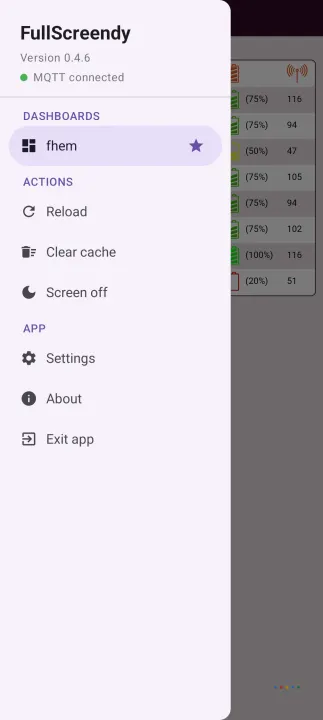
Up to three dashboards, each with its own name, URL, login (HTTP Basic Auth) and certificate setting, so different servers can be mixed. One of them is the default dashboard: it is shown at start and again every time the screen wakes up. The side menu lists them all for switching, and MQTT can switch them too.
The tablet as an FHEM device
Battery level, charging state and temperature, screen state, brightness and volume are reported over MQTT. Incoming commands let FHEM speak text through the tablet, play stored sound files, switch the screen on and off, change brightness and volume, load another URL, reload, clear the cache or vibrate. Everything runs in a persistent foreground service that reconnects to the broker on its own.
Presence and screen
Camera motion detection wakes the display — the image never leaves the device, only a motion flag is published. Instead of letting Android turn the screen off, the app dims it to black with an overlay, so camera and microphone keep running and a touch wakes it instantly, without a wallpaper flash. Optionally the screen can be turned off completely after an even longer idle time.
Voice control in the dashboard
The page can be granted microphone access for speech recognition, and a small JavaScript bridge (window.fullscreendy.textToSpeech) provides speech output, which Android's WebView itself cannot do.
Built for 24/7 operation
Periodic reload against WebView memory growth, memory released under pressure, and the display is brought back automatically if Android ever kills the app.
Why the app asks for these permissions
• Camera — motion detection only; no image is stored or transmitted.
• Microphone — either wake-on-sound (loudness only, no recording) or voice control in the dashboard. You choose which; both at once is impossible.
• Device admin — needed to lock the screen (cmd/lock and "turn screen off").
• Display over other apps — lets the service bring the dashboard back to the front after Android killed it for memory.
• Modify system settings — real hardware brightness over the full range.
• No storage permission at all: the sound folder is picked through the system folder picker, and the app is granted exactly that folder.
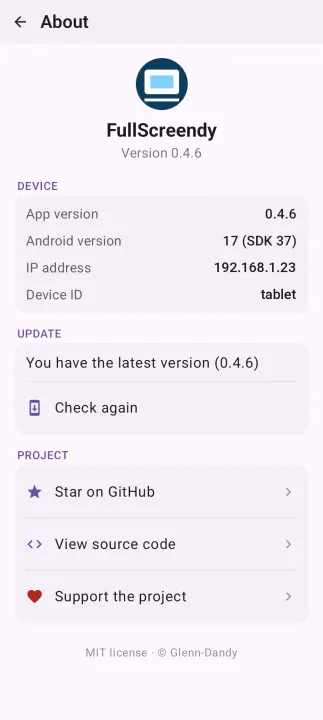
The app only talks to the dashboard and the MQTT broker you configure. The one exception is optional and off by default: if you turn on the update check, the About screen asks api.github.com whether a newer release exists. Nothing is downloaded or installed by the app itself.
Free software, MIT licensed. Interface in English and German.
Dashboards
Up to three dashboards, each with its own name, URL, login (HTTP Basic Auth) and certificate setting, so different servers can be mixed. One of them is the default dashboard: it is shown at start and again every time the screen wakes up. The side menu lists them all for switching, and MQTT can switch them too.
The tablet as an FHEM device
Battery level, charging state and temperature, screen state, brightness and volume are reported over MQTT. Incoming commands let FHEM speak text through the tablet, play stored sound files, switch the screen on and off, change brightness and volume, load another URL, reload, clear the cache or vibrate. Everything runs in a persistent foreground service that reconnects to the broker on its own.
Presence and screen
Camera motion detection wakes the display — the image never leaves the device, only a motion flag is published. Instead of letting Android turn the screen off, the app dims it to black with an overlay, so camera and microphone keep running and a touch wakes it instantly, without a wallpaper flash. Optionally the screen can be turned off completely after an even longer idle time.
Voice control in the dashboard
The page can be granted microphone access for speech recognition, and a small JavaScript bridge (window.fullscreendy.textToSpeech) provides speech output, which Android's WebView itself cannot do.
Built for 24/7 operation
Periodic reload against WebView memory growth, memory released under pressure, and the display is brought back automatically if Android ever kills the app.
Why the app asks for these permissions
• Camera — motion detection only; no image is stored or transmitted.
• Microphone — either wake-on-sound (loudness only, no recording) or voice control in the dashboard. You choose which; both at once is impossible.
• Device admin — needed to lock the screen (cmd/lock and "turn screen off").
• Display over other apps — lets the service bring the dashboard back to the front after Android killed it for memory.
• Modify system settings — real hardware brightness over the full range.
• No storage permission at all: the sound folder is picked through the system folder picker, and the app is granted exactly that folder.
The app only talks to the dashboard and the MQTT broker you configure. The one exception is optional and off by default: if you turn on the update check, the About screen asks api.github.com whether a newer release exists. Nothing is downloaded or installed by the app itself.
Free software, MIT licensed. Interface in English and German.
All versions
| Version | Released | Minimum Android | Size |
|---|---|---|---|
| 0.4.12 | Oct 25, 2026 | Android 9 | 3.8 MB |
How to install an older version of an Android app · How to install an APK file on Android
From the developer (GitHub)
APK files published by the developer on GitHub. They are signed by the developer and may not install over the other builds on this page (different signature). Links open github.com.
Similar apps
-
 Trigger
Open doors via Wi-Fi using HTTPS/SSH.
-
 Dokuwiki Android
Access in local to your dokuwiki
-
 K-9 Mail
Full-featured email client
-
 Screenshot Tile (NoRoot)
Customizable screenshot tool with quick settings shortcut and floating button
-
 Coffee
Keep display awake
-
 Mute reminder
Remind you to mute media
-
 Prepaid Balance
Keep track your prepaid balance
-
 Auto Auto-Rotate
Automatically remembers your auto-rotate setting for every app